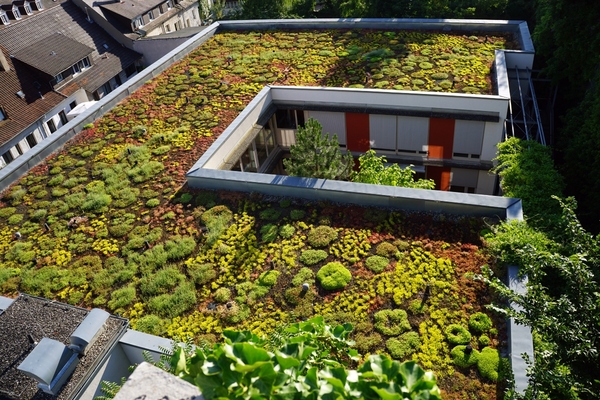
Everything You Need To Know About Green Roofs For Commercial Buildings
When we generally refer to commercial green roofs, we refer to roofs that have been made to grow and accommodate plants. These kinds of roofs typically are mounted on flat roofs and are often used as gardens, farms, parks, and research centers, although they have numerous other functions. Before getting a commercial green roof for your office building or business, you first need to be briefed on its intricacies. In this post, we aim to provide you with all the layers of information that you need to help you make the right choice. There are a lot of factors to consider before getting a commercial green roof, like the irrigation system, soils, structural requirements, etc.
Types of Green Roofs
There are three main types of green roofs for you to choose from. We have carefully detailed them, citing both their advantages and disadvantages.
- Intensive
If you’ve seen a green roof somewhere in your city, there’s a high chance it’s an intensive green roof as it is the most common type of commercial green roof. These kinds of green roofs serve a variety of purposes. They can be used as gardens, and walkways, and can even hold entertainment spaces. Green roofs often support the weight of more than two people at a time, so their installation process must be done right. It must be installed on a flat roof with a pitch measuring less than 2:12. If you intend to support plants that require deeper roots, it is advisable you get a deeper intensive roof that is capable of supporting these plants. However, you must ensure you have compensated for the additional weight on the building this will cause.
- Brown Roof:
One unique advantage of brown roofs is that they provide the community with benefits rather than wreak havoc. Brown roofs basically are just normal living roofs that are capable of tackling problems in the ecosystem and supporting the growth of biodiversity. For instance, if you have an endangered species that needs tending to, your brown roof is great as a source of food and habitat. You however need to ensure that the species can survive on your brown roof before making it its habitat.
- Semi-intensive
Semi-intensive roofs are similar to intensive with a few key differences like the fact that semi-intensive roofs are more shallow. They measure anywhere from 6 to 10 inches which is great for supporting some grasses and bushes, but not trees and tall shrubs. This is because these tall shrubs and trees require deep roots that the semi-intensive roof can’t provide.
Their advantage over intensive roofs however is that they are significantly more versatile than intensive roofs. They can be installed almost anywhere, from roofs with a low slope, to flat roofs, and roofs with a pitch that is less than 4:12. An average semi-intensive green roof is not created with the facilities to be consistently walked on. And so, this should be avoided at all costs.
- Extensive
Extensive roofs are by far the shallowest of all the green roofs we have listed so far. With a depth of about 6 inches, these roofs are not suitable to support plants that possess an in-depth root system. Instead, these roofs are just made to support plants like sedums and mosses. In most cases, these extensive roofs just serve residential buildings. This is mainly because they can be placed on high-sloped roofs that are up to 12:12.
Irrigation Systems for Green Roofs
Water is a crucial part of sustaining plants. This is why you need an efficient irrigation system to ensure that your plants are appropriately watered. With an intensive green roof that supports more plants than other green roofs, the water needs are significantly more. Here are some options you can employ to provide the water you need to ensure your roof gets an adequate supply.
- Spray irrigation
If you take a cursory look at most front lawns, you will find out that this method of watering is usually employed to provide water for the lawns. The water is distributed with the use of sprinkler heads which distributes water on a steady schedule. “Micro-sprays” are also employed to deliver water to localized regions efficiently without fear of the water evaporating quickly. The downside however is that wind can easily blow the spray away causing some parts to be deprived of water.
- Drip irrigation
Drip irrigation is a form of water delivery that distributes water to different locations by dripping consistently and in small amounts at different points on the roof. It is a great way to deliver water to large plants that often require a consistent water supply like vegetable plants, trees, or other large plants. You can either install this system to deliver water from inside the drainage or substrate layer or from above the plants.
- Drainage layer irrigation
Another method of irrigation for your commercial roof that you can utilize is flooding the drainage or substrate layer from the inside with water. This method provides optimum results as evaporation is kept at a minimal level and so you can minimize water costs. With this method, however, you may not be able to target specific areas of the roof that require more water. You may also not be able to distribute the water to the substrate level where it is needed more.
For both drip and spray irrigation systems, you can install certain features that help you get water to the larger roof spaces. This also means that you can customize your water delivery system to better suit your roof needs. Additionally, to minimize water wastage, you can install sensors that will detect rain and stop the system from delivering water. You could also install features that could regulate water delivery, and restrict it to certain periods.
Plants suitable for Green Roofs
The plants that can be commonly found in both extensive and semi-intensive green roofs are short plants like sedums and mosses. If you want to plant a larger variety of plants, you will have to opt for an intensive roof. They are capable of supporting small trees and larger plants. Here are some plant options you can adopt for your green roof.
- Native plants
A very popular plant choice involves the planting of common plants that are native to the environment around your green roof. There are numerous plants to choose from. The Vancouver Convention Center for instance has over 400,000 grass and plant species that are native to that region. With these native plants, there will be a constant supply of food and habitat for wildlife and insects. This promotes the biodiversity of any region. This is why you must ensure that you invest in native plants, as it will improve the diversity of biological animals in that area.
- Productive plant
As we have earlier mentioned, your green roof can serve as a farm or garden to grow any plant in your area. The only restriction to this very fact is when you attempt to grow very tall plants that require a lot of soil room to be able to flourish. Additionally, you may also not be able to grow plants that have aggressive roots on your green roof. To be able to supply nutrients for heavy feeder plants like tomatoes or grains, you will need to dilute the nutrients into the water before watering the plants as not many substrate materials can provide these nutrients.
- Landscaping plants
If you install a green roof that is capable of serving as a park rather than a garden, you can plant several landscaping plants. You can consult a landscaper that is native to that region for recommendations on low-maintenance plants that are unique and well-adjusted to that area.
Structural Requirements for Green Roofs
Before you install a green roof onto any structure, you must first ensure that the structure is capable of supporting the soil, plants, and other layers that come with the system. And so, you have to ensure that the structure is capable of supporting heavy loads like these plants and green roofs before you install one on the building. If you’re dealing with an intensive roof, you have to be extra certain of the amount of load that building can take because these types of roofs add significant load to any building. Apart from the soil and plants, water is also a huge part of the weight. The overall weight is dependent on the materials chosen, and the type of system used. The range however is anywhere from 50 to 500 lbs per square foot. You must also consider the weight of people that will stand on this roof at a time. When determining if the structure can carry the roof’s weight, ensure you factor in that of people that will also stand on the roof.
The difference in weight is also a huge consideration in the type of commercial green roof to select. You must determine the right one before you can begin installation or construction begins on the building. If you decide to install one in an already-standing building, a structural engineer or architect must be present to design changes that are needed to accommodate the green roof system. The level of changes needed largely depends on the nature of the building that you’re working with and the type of green roof you wish to install.
Advantages of Commercial Green Roofs
Here are some advantages to installing a green roof
- Beauty: The beauty green roofs add to buildings is undeniable. You can plant any number of beautiful plants on your green roof to improve the aesthetics of the environment.
- Reduction of heating and cooling costs: Green roofs can offer you great insulation thereby stabilizing the temperature in any building. They are capable of absorbing UV radiation which causes heat in buildings. While the plants maintain heat in the winter, thereby lowering heating costs.
- Longer membrane life: The ability of green roofs to absorb UV radiation also makes them great for insulating the bitumen membranes beneath them. The National Roofing Contractors Association (NRCA) revealed in the 2007 Green Roof System Manual that green roofs increase the service life of roofing membranes by absorbing UV radiation.
- Selling point: Buildings with green roofs often are more appealing to tenants and occupants than buildings without a green roofs. This can attract more residents to your office buildings, apartment buildings, entertainment spaces, etc.
- Research possibilities: Research facilities often rely on green roofs to research and explore possibilities in life sciences.
- Stormwater management: The presence of large plants on green roofs helps in water absorption during heavy rainfalls.
- Plant production: If you run a business that produces plants, you will be in a great position to grow these plants in urban areas with the help of a green roof.
- Solar panels: The addition of a green roof to solar panels can result in numerous other benefits. With solar panels, you no longer need to rely on electricity to run your building.
- Property value: Green roofs generally increase property value. Buildings with these green roofs can be seen as an asset by buyers which increases how much they would bid for it.
- Urban heat islands: The Urban Heat Island Effect refers to the increase in the city’s temperature as a result of the accumulation of asphalt on roads and rooftops. Green roof significantly lowers this effect leading to extra comfort and lower cooling costs in your building.
- Biodiversity: As we stated, green roofs are great sources of food and habitat for all kinds of insects and animals which causes even more diversity in the biological status of the region.
Disadvantages of Commercial Green Roofs
While there are several benefits of green roofs, they also come at a huge price. Here are a few of its disadvantages:
- Installation costs: The costs of installing a green roof often discourage many who initially show interest. The installation process includes basic requirements for a flat roof and more layers to accommodate the plants.
- Maintenance: You also need to conduct periodic maintenance for your green roofs to ensure they retain their aesthetic quality. You need to replace dead plants, fix or maintain the irrigation system, replace materials, etc. The maintenance cost usually matches that of a garden or lawn that measures the same size.
Green Roof Cost-Benefit Analysis
While it can be a hassle determining the precise cost of a green roof, your green roof manufacturer should be able to give you an estimation of installation cost per foot. If the building also requires any changes to the structure, then you also need to factor in the cost to the overall amount. You can also determine the cost for yearly maintenance of your green roof by either estimating or employing the services of a professional.
Once you have successfully estimated the cost to run your green roof, you must then compare it to the benefits you enjoy from the green roof. For instance, you need to determine if the cost of your green roof is worth it if it lowers your heating and cooling costs. If your green roof also helps you attract more tenants, you must determine if it is profitable and if the presence of the green roof is sufficient to increase your rent. While it may be difficult to determine the profitability of some benefits, you can arrive at a conclusion from the benefits you can analyze.